
The voice that navigated was definitely that of a machine, and yet you could tell that the machine was a woman, which hurt my mind a little. How can machines have genders? The machine also had an American accent. How can machines have nationalities? This can’t be a good idea, making machines talk like real people, can it? Giving machines humanoid identities? -Matthew Quick, Author of The Good Luck of Right Now
Texting or Calling: What’s Your Poison?
According to a 2011 Pew Research survey, 83% of American adults own cell phones and 75% of them send and receive text messages. In the study, individuals from the Black[*] and Hispanic ethno-racial groups sent/received the most amount of texts per day (remember this for later), and the educational level of the heaviest texters was less than high school (this is also important).
While the survey admits that these numbers are stagnate from the year before, if we flashforward to a 2015 International Smartphone Mobility Report by Informate, we know that US smartphone users spend 21 minutes a day on a call and spend 26 minutes a day texting. The smartphone users make only 6 calls per day, while they send/receive 32 texts; that’s more than 5 times as many texts as calls.
The verdict: It’s safe to say that more Americans prefer to text nowadays than they prefer to call. Trust me, I’m a Millennial.
Does Education have Anything to do with This?
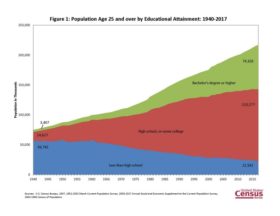
The gap on educational attainment has increased exponentially in the last 77 years. This 2017 United States Census Bureau’s graph depicts the Education Attainment between 1940 and 2017
While the number of people who attain an education less than 9th grade has decreased, it still stands that most of the population age 25 and older are only getting as high as a high school diploma. We also still have the issue of people not reaching that level. The same can be said if we narrow the scope of educational attainment to just Orlando, Florida. According to Statistical Atlas, 44.9% of people age 25 and older living in Orlando have a high school diploma, 43.5% have a post-secondary degree, and 11.6% have no high school diploma. The two ethno-racial groups who have the highest percentage of individuals lacking high school diplomas are Hispanics and Blacks (Remember the statistics from above?). These groups also have the lowest percentage of college graduates. Additionally, if you look at the Median Household Income by Race, Hispanics and Blacks have the lowest household income.
What’s the Correlation Here?
So, low education level combined with high amounts of texting may result in a huge discrepancy in the English language. Texting, tweeting, DMing, etc. contributes to the quick pace of emerging slang. Our chatbot will be utilized with low-income ehtno-racial groups who either do not have English as their main speaking language, or do not have a high educational attainment. Because Hispanic and Black communities have the lowest household income of most ethno-racial groups in Orlando, these groups will most likely be using our chatbot more than anything. I also want to point out that 22.5% of households in Orlando speak Spanish at home, which contributes to poor English grammar.
The Natural Language Processing (NLP) aspect will be one of the hardest challenges. We have to take into consideration that slang and less-than-perfect grammar usage will not be common with the Hispanic and Black communities.
The Solution?
Is “y’all” proper English? Will the chatbot be able to understand that the user is saying “you all?” I spoke with my supervisor and IT Director, Josh Lazar, on what we can do to overcome the challenge of handling users who do not speak proper English:
“We have to first teach the bot proper English. We must give it the basics and make sure it has a great understanding of the English language. Using tools like ReadClearly and WriteClearly may help when it comes time to training the bot how to understand.”
Training the bot on a 5th to 8th grade understanding of the English language is the ideal solution. If the bot can speak at a level that most users can understand, individuals with low educational attainment will be less intimidated. Then we can teach it slang through a feedback loop. We can keep a log of conversations that the chatbot did not comprehend clearly and classify the data as either jargon or slang. This data will be circled back to the chatbot to learn the difference between someone trying to confuse the chatbot and someone who doesn’t have proper English.
ICYMI (“In Case You Missed It”): Check out Microsoft’s derp moment in 2016 when it released a Twitter AI chatbot. The chatbot was an experiment where it would get smarter the more people chatted with it. However, it went from “Hello, world” to “Destroy world” real quick.
[*] I am using this term because it correlates with the data found throughout the post. I apologize for anyone who may feel disrespected